"Senior Visiting Scientist" opportunity with the WHO Classification of Tumours Programme. More details
Come to visit us at the European Congress of Pathology in Stockholm, Hall B, stand 253, from 12 to 15 September 2026.
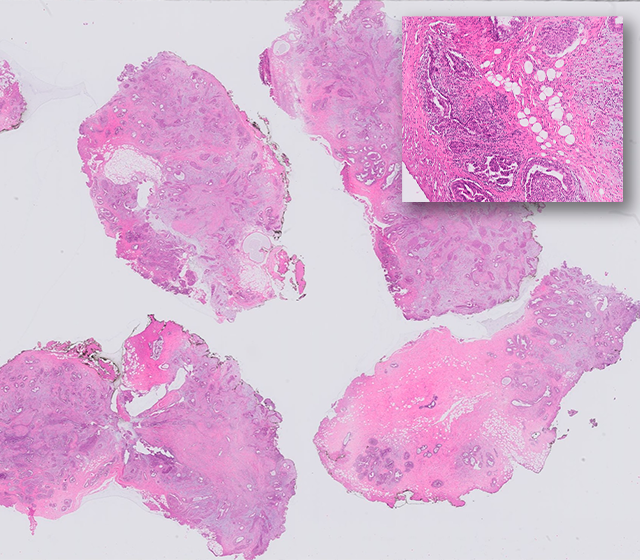
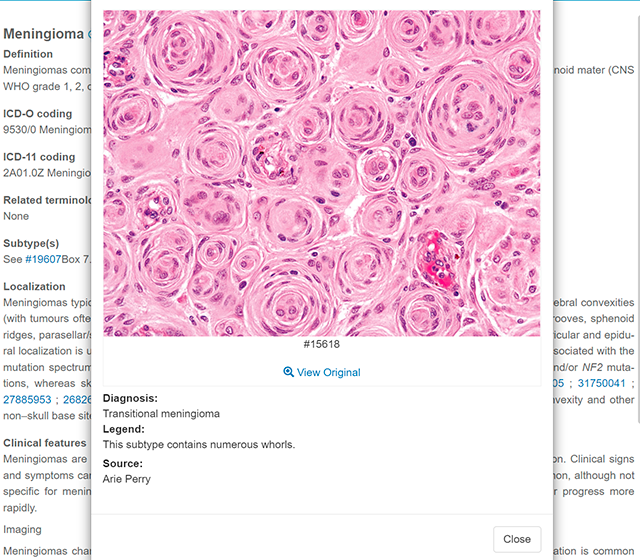
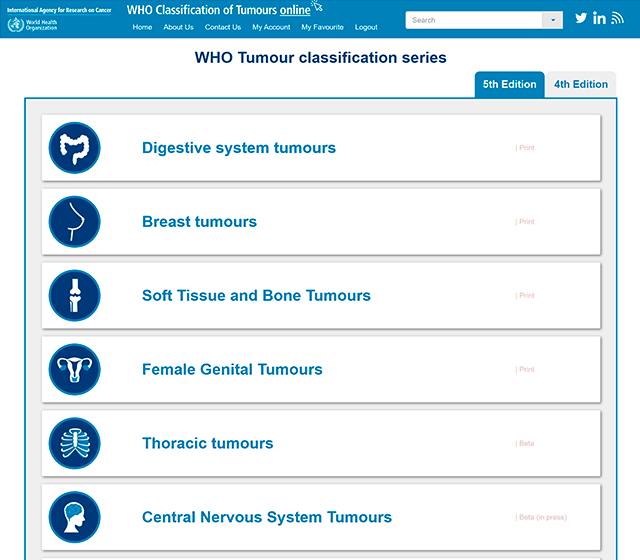
WHO Classification of Tumours Online presents the authoritative content of the renowned classification series in a convenient digital format. Now combining the fourteen most recent volumes of the series in a searchable format, with high quality images and whole slide images.
WHO Classification of Tumours Online is indispensable for pathologists and cancer specialists worldwide. New volumes will be added regularly, ensuring immediate access to the latest content.
Don't have an account? Subscribe
The International Classification of Diseases, 4th edition, (ICD-O-4), has a new morphology structure, with five-digit morphology codes, in which the fifth digit is either 0 or another alphanumeric value for more-specific coding.
This approach was chosen to enable continuity and consistency with previous editions while greatly increasing the number of unique codes that can be assigned.
Consult ICD-O-4 online
The WHO Reporting Systems for Cytopathology are a joint project of the International Academy of Cytology, and the International Agency for Research on Cancer, a specialized agency of the World Health Organization. This series is a synthesis of the published evidence and the practice of cytopathology, linked to the WHO Classification of Tumours, now in their 6th Edition. Cytopathology reporting uses a hierarchial system of diagnostic categories. These categories are linked to diagnostic management recommendations to improve communication with clinicians and assist patient care.